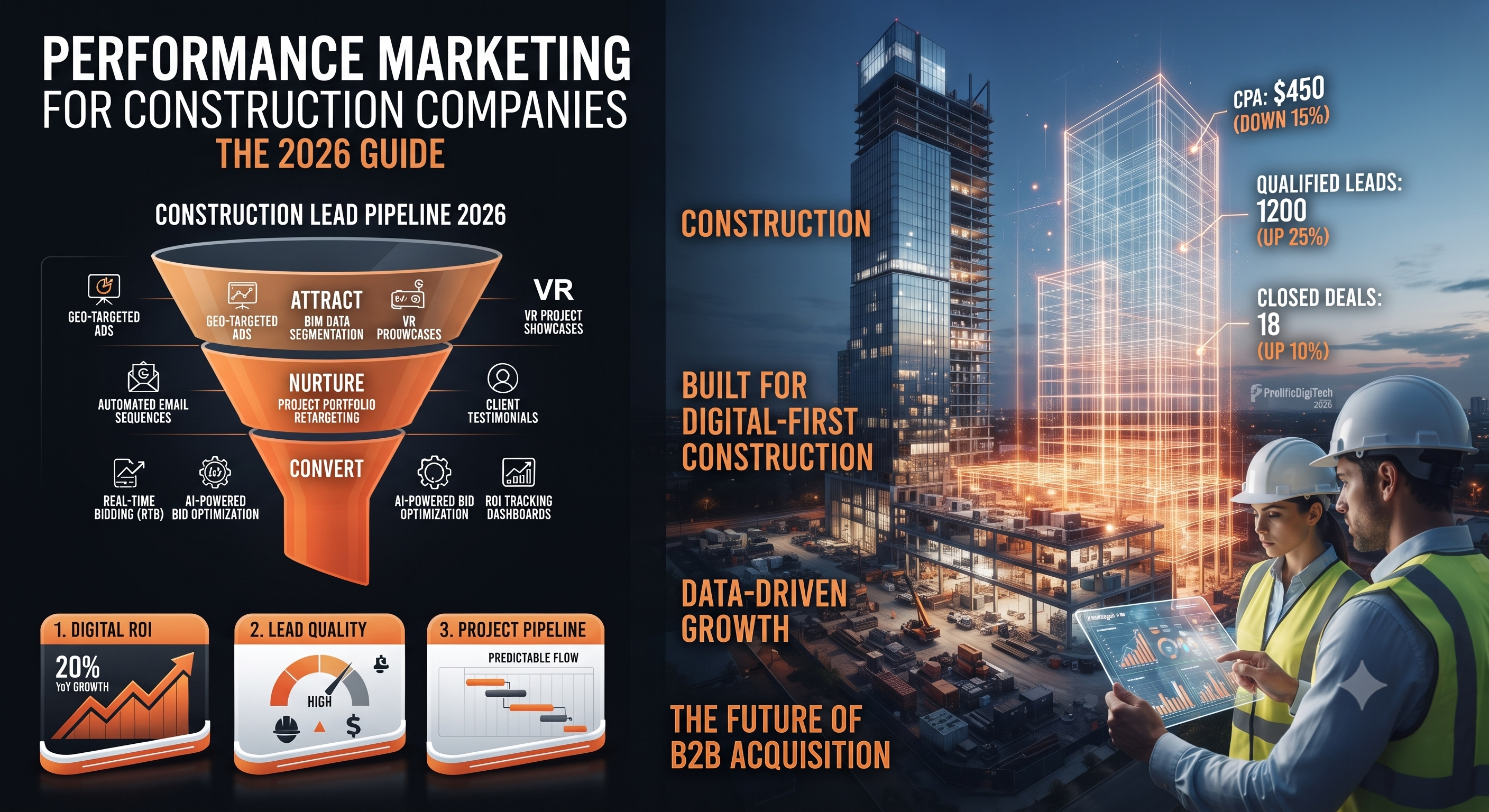
For most construction companies in Australia and the United States, marketing has traditionally meant a website, a few social media posts, a listing in a directory, and hoping referrals keep the pipeline full. That approach worked when the market was smaller and less competitive. In 2026 it does not. The construction businesses growing consistently are the ones that have moved from hope-based marketing to performance marketing — where every dollar spent is tracked, measured, and tied directly to a booked project enquiry.
What Performance Marketing Actually Means for a Construction Business
Performance marketing is marketing where you pay for measurable outcomes rather than exposure. Instead of spending money on a billboard and guessing whether it generated any work, performance marketing connects every campaign to a specific, trackable result — a form submission, a phone call, a booked appointment. For a construction company, that means knowing exactly how many project enquiries came from Google Ads last month, what each enquiry cost, and which of those enquiries turned into a signed contract.
This matters more in construction than in almost any other industry, because the value of a single project is so high. A custom home builder in Sydney or a design-build contractor in Dallas is not selling a fifty dollar product. They are selling projects worth hundreds of thousands of dollars. When a single signed contract is worth two hundred thousand dollars or more, spending two thousand dollars a month to reliably generate qualified enquiries is not an expense — it is one of the highest-return investments the business can make.
Why Referrals Alone No Longer Fill the Pipeline
Referrals and word of mouth are valuable, and they will always be part of a healthy construction business. The problem is that they are unpredictable and they do not scale. The volume of referral enquiries is directly tied to how many projects the business recently completed and who those clients happen to know. When work slows down, referrals slow with it — exactly when the business needs new enquiries most.
The bigger issue is that referrals only reach people who already know someone who used you. Every homeowner in Melbourne or Miami who is searching online for a builder right now — and has no connection to your past clients — never finds you. Research consistently shows that the vast majority of construction buyers research firms online before making contact. If your business is not visible where those people are searching, they are hiring your competitors.
The Core Channels of Construction Performance Marketing
Performance marketing for a construction company is not one tactic. It is a coordinated system where each channel plays a specific role, and everything is tracked so you know what is working.
Google Ads — Capturing Active Demand
Google Ads captures people at the exact moment they are searching for what you offer. When a homeowner in Brisbane searches for a custom home builder, or a business owner in Houston searches for a commercial contractor, a well-structured Google Ads campaign puts your business at the top of the results. This is the highest-intent channel available — the person has already decided they need the service and is actively looking for someone to deliver it. Google Ads delivers qualified enquiries immediately, which is why it is the fastest-performing channel for most construction businesses.
Meta Ads — Building Demand Before the Search
Facebook and Instagram ads reach homeowners and business decision-makers before they start actively searching. Construction is a visual industry, and completed project photography, before-and-after transformations, and short video walkthroughs perform extremely well on these platforms. Meta Ads build awareness so that when a prospect does begin their search, your business is already familiar to them. This is particularly powerful for larger projects where the decision to build or renovate is made months before the prospect starts contacting contractors.
SEO and Local Search — Long-Term Visibility
Search engine optimisation and a fully optimised Google Business Profile build long-term organic visibility that does not require paying for every click. For local construction businesses, the Google Business Profile is often more important than the website itself — it is what appears in the local map results when someone searches for a builder in their area. Ranking well organically means enquiries continue arriving even when ad budgets are paused.
AEO and GEO — The 2026 Frontier
The newest and fastest-growing channel is Answer Engine Optimisation and Generative Engine Optimisation — ensuring your business appears in AI-generated answers from tools like Google AI Overviews, ChatGPT, and Perplexity. In 2026, a growing share of homeowners and business owners ask AI assistants questions like what should I look for in a commercial construction company or who are the best custom home builders in my area. If your website content is structured to answer these questions clearly and authoritatively, AI engines cite your business as a source — a powerful new form of visibility that most of your competitors are not yet capturing.
The Missing Piece: Lead Qualification and Speed to Contact
Generating enquiries is only half of performance marketing. The other half — the half most construction businesses get wrong — is what happens after the enquiry arrives. Research consistently shows that the contractor who responds to an enquiry first converts at a dramatically higher rate than those who respond hours or days later. In construction, where a prospect is often contacting several businesses at once, the first company to call back with the right questions wins a disproportionate share of the work.
This is why the strongest performance marketing systems include a qualification step — every enquiry called within five minutes, filtered by budget, location, timeline, and project type, so that only genuine, ready-to-proceed prospects are booked into the calendar. Without this step, a business pays to generate enquiries and then loses them to slow follow-up. With it, every marketing dollar works harder.
What Construction Companies Should Budget in 2026
Industry benchmarks in 2026 recommend construction companies allocate a meaningful percentage of revenue to marketing, with the majority directed toward digital channels. For most small to mid-sized builders and contractors in Australia and the USA, a comprehensive performance marketing programme — covering paid ads, SEO, content, and tracking — represents a monthly investment that is modest relative to the value of a single won project. Companies that commit consistently to marketing measurably outperform those that treat it as an afterthought. The key is not how much you spend, but whether every dollar is tracked and tied to a result.
Getting Started with Performance Marketing
If your construction business is relying primarily on referrals and experiencing the unpredictable feast-and-famine cycle that comes with it, moving to a performance marketing system is the single most impactful change you can make. It begins with a proper digital foundation — a fast, conversion-focused website with full tracking configured — followed by the paid channels that generate enquiries and the qualification process that converts them. See how performance marketing works for construction companies in Australia and the USA — you can book a free audit from there.