Two builders start renovation businesses in the same city around the same time. Both skilled, both reliable, both with strong early reputations. Ten years later, one runs a $2.4 million business with a team of twelve and a forward calendar booked four months out. The other is doing roughly the same revenue as year three, with good months and terrible months alternating unpredictably. Same city, same skills, same starting point — so what actually separated them?
Every Asset You Own Is Losing Value
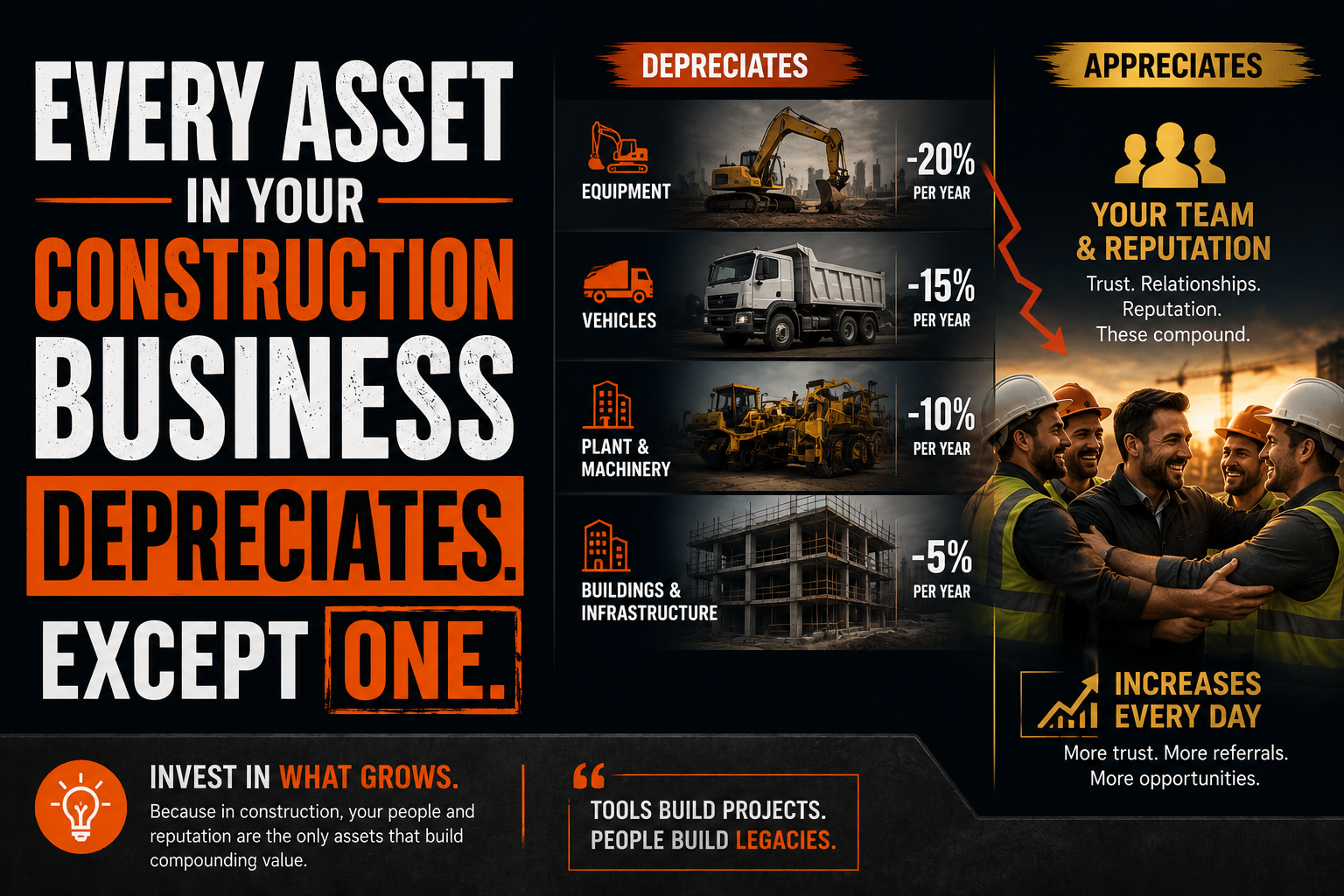
Every physical asset in a construction business depreciates — the equipment, the vehicles, the tools. The accountant writes it off annually. More uncomfortably, even skills slowly get commoditised as the market gets more crowded, as tutorials teach homeowners enough to ask harder questions, and as clients who once hired on trust alone now collect three quotes before deciding. The craft that once gave an uncopyable advantage becomes table stakes.
The One Asset That Compounds
A performance-based lead generation system, built correctly and run without interruption, is the only asset in a construction business that gets more valuable every single month. Most builders think of marketing as an expense — something to spend on in quiet periods and cut when busy. That thinking is the single most expensive mistake in the industry, because a properly built system is a compounding asset, not a cost centre, as covered in more depth in our guide to performance marketing for construction companies.
How the Compounding Actually Works
In month one, the data is thin and cost per qualified lead is relatively high. By month three, the campaign has accumulated enough conversion data to optimise properly, and cost per lead has often dropped 30 to 40%. By month six, the system knows the business's market better than any agency starting fresh — which suburbs produce the highest value clients, which keywords convert best. By month twelve, a competitor starting from scratch would need a full year just to catch up to where the compounding system already stands.
Why Most Builders Never Build It
Three understandable reasons: starting only when the pipeline is empty, which conflicts with the time a compounding system needs to build momentum; the referral illusion, where urgency disappears the moment referrals are flowing; and past experience with agencies structured to benefit regardless of client outcomes, rather than genuine performance marketing where the agency only earns when the client does.
This same compounding logic applies directly to marketing for residential architects — the firms that invest in a system early are the ones still compounding an advantage a year later, while competitors are still starting from zero.